Saltar para o conteúdo

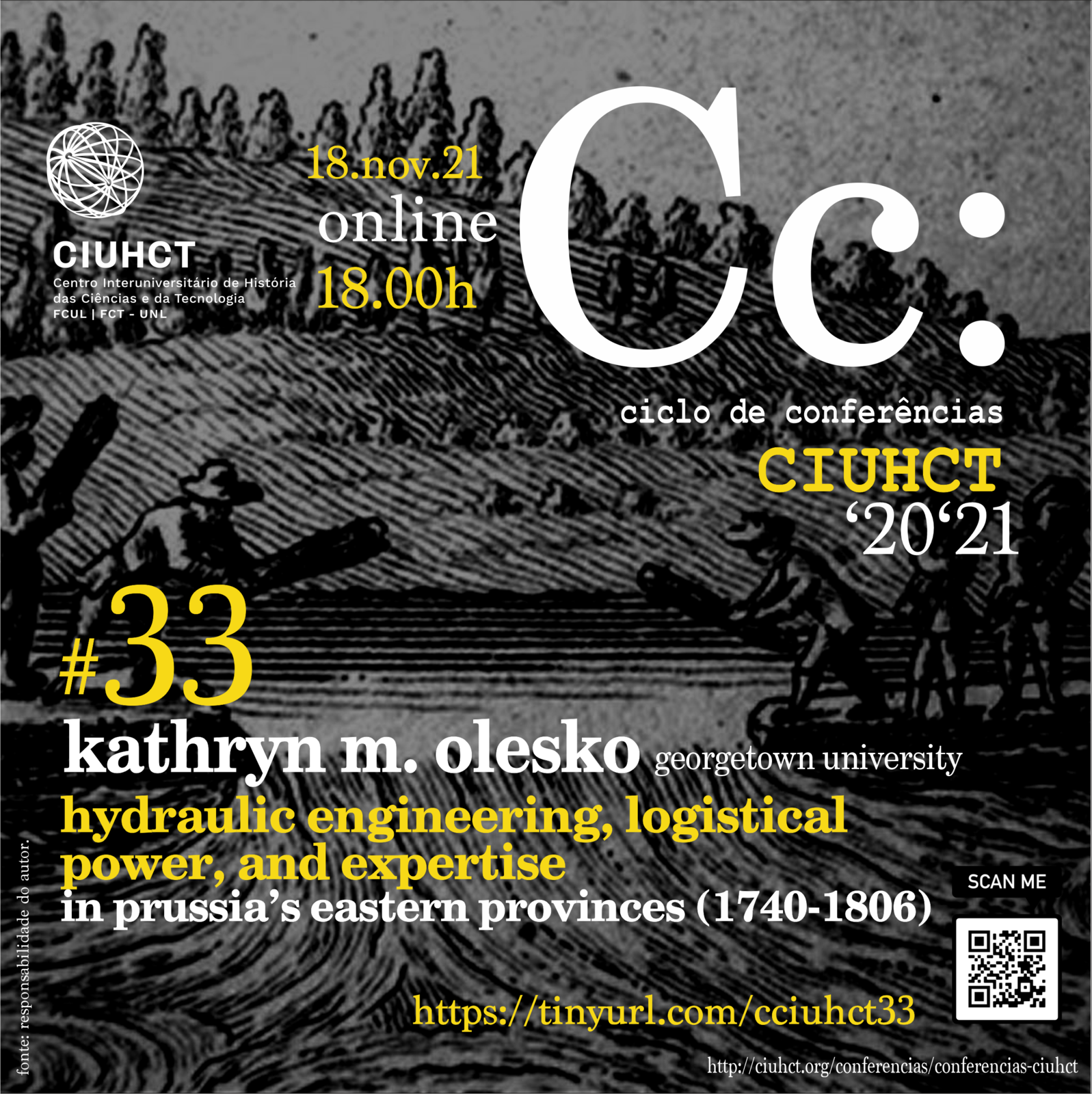
#33. Hydraulic Engineering, Logistical Power, and Expertise in Prussia’s Eastern Provinces, 1740-1806

com Kathryn M. Olesko (Georgetown University)

[Online]

18 novembro 2021 · 18h00

33_olesko.png

Resumo (em inglês)

Prussia’s rapid expansion eastward between 1740 and 1806 provided opportunities to reclaim land for the settlement of German colonists, to rectify rivers to speed up transportation, to control floods through the reinforcement of river banks, and to build canals to transform waterways. This lecture treats Prussia’s projects in hydraulic engineering as examples of logistical power: the state’s ability to transform the material world by planning, executing, and managing projects on the ground for the purpose of projecting its control over the natural and built worlds. The exercise of logistical power necessitated the creation, curation, and support of technical expertise. Projects in hydraulic engineering became a reservoir of strategies—technical and metaphorical—for coping with social and political change. 

Sobre a oradora (em inglês)

Kathryn Olesko is Professor Emeritus at Georgetown University. Her main research interests include measuring practices, science pedagogy, science and engineering in Germany (especially Prussia), and comparative nuclear cultures. She is the author of Physics as a Calling and over fifty articles. She edited twelve volumes of Osiris. Her current projects include studies of: hydraulic engineering in Prussia’s eastern provinces, Gustav Kirchhoff as a student, a short biography of Friedrich Wilhelm Bessel, and German nuclear culture on both sides of the Iron Curtain during the Cold War.

*Legenda da imagem
Laborers laying Faschinen for a dike. 

De:
Heinrich Carl Riedel, jr., “Über unvorhergesehene Unfälle bey Coupirung der Deich-Durchbrüche,” Sammlung nützlicher Aufsätze und Nachrichten, die Baukunst betreffend 3.1 (1799), Extracted from Taf. II, Situations Plan der Belitzer Schleuse

Foto tirada pelo autor com a permissão de Niedersächsische Staats & Universitätsbibliothek.

  • Link Zoom
  • Agenda
  • Membros
    • Distinguished Lectures
      • Expert Astrologers and Print Culture in the Early Sixteenth Century
      • The Anthropocene: a gender and decolonial critique
      • Keep Calm and Hazard the Campus. Students, publics and non-publics in a nuclear South-European cityscape
      • Invisible Technicians, Traveling Woodblocks, and Practices of Visual Knowledge in Early Modern Europe: The Thurneysser-Mattioli Connection
      • Technological and Medical Aspects of Tea Plantations in Colonial South India
      • #18. Ricardo Carlos Smith, a forgotten pioneer of Portuguese horticulture
      • #21. Jesuit petitioners for the indies: the role of scientific skills and blood in their letters (XVII-XVIII c.)
      • #29. Open and Shut: A Brief History of the Changing Expectations of the Hospital Window
      • #30. The 1919 Eclipse Expedition: Science between the Portuguese and British empires
      • #32. [Adiada]
      • #34. Dealing with the Plague in Oporto A Matter of Global Epidemic Diplomacy at the turn of 19th and 20th century
      • 2022 #1 Simon Schaffer (University of Cambridge), "Astronomy colonized: British orientalism and astral sciences in northern India"
      • 2022 #4 Londa Schiebinger (Stanford University), "Gendered Innovations: Enhancing Excellence in Science & Technology"
      • 2022 #8 Andreas Fickers (Luxembourg Centre for Contemporary and Digital History), "How to grasp the meaning of past media technologies in re-use"
      • 2022 #10 Naomi Oreskes (Harvard University), "The Big Myth: How American Business Taught us to Loathe Government and Love the Free Market"
      • 2023 #2 Marco Beretta (University of Bologna), "A reassessment of Lavoisier's collection of scientific instruments"
      • 2023 #3 Sanjoy Bhattacharya (School of History, University of Leeds), "Who is the WHO?: Decolonising histories, theory and practice"
      • 2023 #4 Sam Robinson (Royal Historical Society; ICHO), "Ocean Science, Diplomacy and the United Nations" [Nova data]
      • 2023 #5 Cristina Brito (CHAM, NOVA FCSH), "People(s) and manatees in the early modern Atlantic: A marine environmental history approach"
      • 2023 #9 Gloria Clifton (Royal Museums Greenwich), "Unearthing the activities and contributions of women instrument makers (17th-19th centuries)"
      • 2024 #3, Juan Acevedo (CIUHCT, ERC Rutter Project), "Science & World Philologies: A Match Made in the Nine Heavens"
      • 2025 #1, com Robin Wilson (Open University; Gresham College, London), "Lewis Carroll in Numberland: The Mathematics of C.L. Dodgson"
    • Journal Club
    • Jardins, Paisagens e Ambiente
    • Mathematical Cultures
    • O Arquivo e o Historiador
    • Cultura Material
    • Medea Chart
    • Outros ciclos
  • Congressos
  • Recursos
  • Contactos
  • Newsletter
pt en